OCD Help That Works
How Exposure and Response Prevention (ERP) with an OCD Therapist Can Change Your Life
If you’re searching for OCD help, you may already know how exhausting obsessive-compulsive disorder can be. Maybe you’ve been stuck in intrusive thoughts that feel disturbing or “not like you.” Maybe rituals are taking up more time than you want to admit. Maybe you’re constantly second-guessing yourself.
Working with a specialized OCD therapist — especially through structured virtual OCD therapy — can make effective treatment accessible and life-changing. One of the most evidence-based approaches for OCD is Exposure and Response Prevention (ERP), a therapy designed specifically to reduce intrusive thoughts and compulsions without reinforcing the OCD cycle.
Let’s talk about what ERP actually is, what to expect, and why finding the right OCD therapist matters.

What Is Exposure and Response Prevention (ERP)?
Exposure and Response Prevention is considered the gold-standard treatment for OCD.
Here’s the simple breakdown:
Exposure = Gradually facing the thoughts, images, objects, or situations that trigger your OCD.
Response Prevention = Choosing not to engage in compulsions, rituals, reassurance, or avoidance behaviors.
OCD survives on avoidance and rituals. When you repeatedly face fears without performing compulsions, your brain learns something powerful:
“I can handle this. I don’t need the routine to be safe.”
Over time, anxiety decreases because your nervous system recalibrates — not because you forced it down, but because you retrained your response.
This is what real OCD help looks like: changing the pattern, not just managing symptoms.
How an OCD Therapist Provides Effective OCD Help
Not all therapists specialize in OCD. And that matters.
An experienced OCD therapist understands:
The difference between intrusive thoughts and intent
How mental compulsions (rumination, replaying, checking feelings) keep OCD stuck
How reassurance strengthens the cycle
How to structure exposures safely and gradually
How to move at a pace that builds confidence
ERP is powerful, but it needs to be done correctly.
A trained OCD therapist will never:
Throw you into your worst fear on day one
Force you into unsafe situations
Shame you for your thoughts
Ask you to do something they wouldn’t do themselves
ERP is collaborative. Structured. Gradual. And safe.
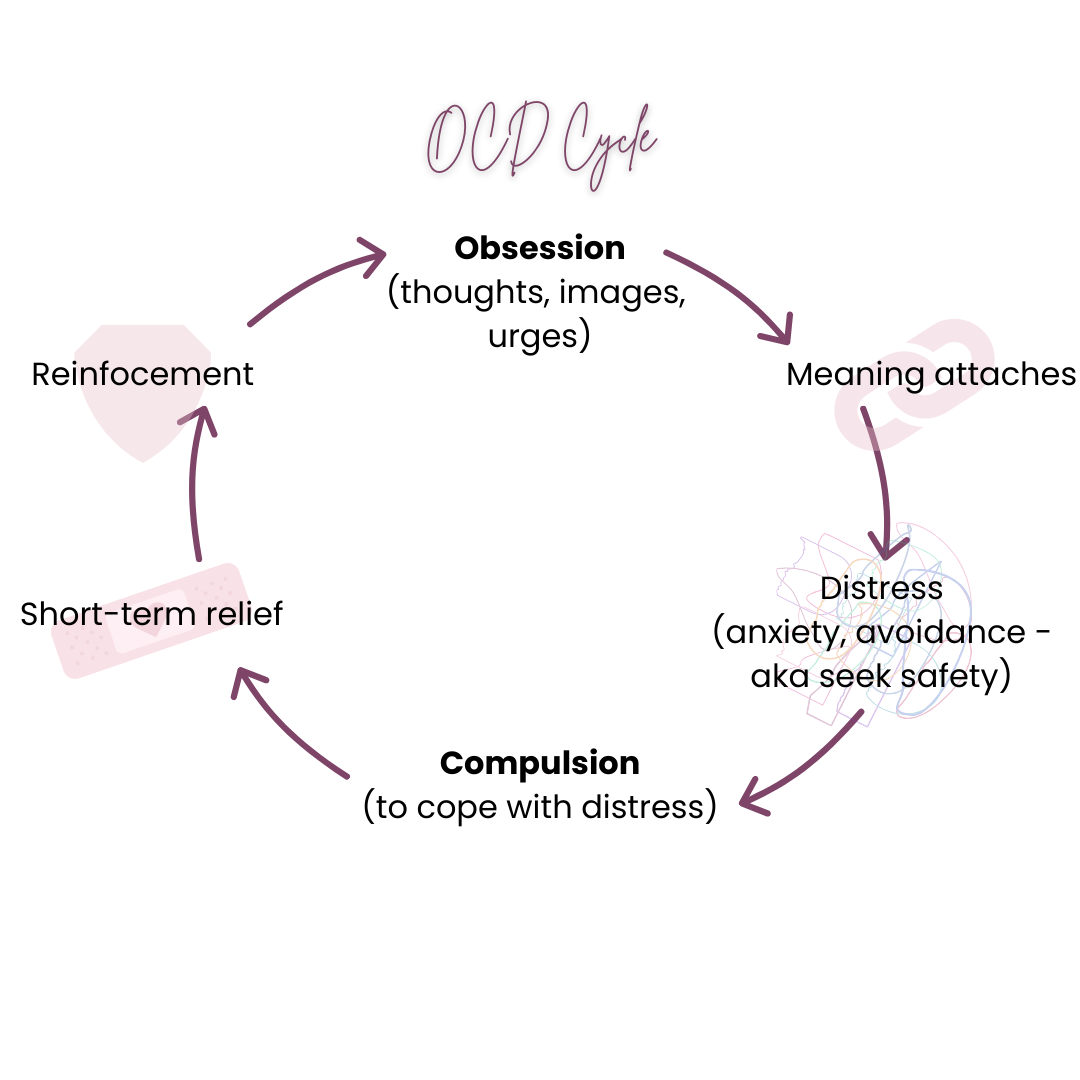
Understanding your OCD cycle is important. It allows for treatment to be tailored to you and helps you break from being at the mercy of OCD.
What to Expect in Virtual OCD Therapy
Many people are surprised to learn how effective virtual OCD therapy can be.
In fact, working virtually can enhance treatment because you complete exposures in your real-life environment — your home, your kitchen, your car, your workplace — where OCD actually shows up.
Here’s how treatment typically unfolds:
Stage 1: Education
Before exposures begin, your OCD therapist will help you understand:
What intrusive thoughts are
Why compulsions temporarily reduce anxiety
How reassurance keeps OCD alive
Why avoidance shrinks your world
Many clients say this stage alone feels relieving.
You begin to realize: “This isn’t me. This is OCD.”
Stage 2: Mapping Your OCD Cycle
OCD isn’t one-size-fits-all and looks different from person to person.
You and your therapist will identify:
Triggers
Intrusive thoughts
Compulsions (including mental rituals)
Avoidance patterns
Whether it’s contamination fears, harm OCD, relationship OCD, scrupulosity, time spent on checking things again and again, health anxiety, postpartum OCD, or “just right” perfectionism, your treatment plan is tailored.
This clarity becomes your roadmap for OCD help that actually works.
Stage 3: Building an Exposure Hierarchy
An exposure hierarchy is simply a graduated list of feared situations ranked from mild to high distress.
You do not start at the top.
You start small.
Examples:
Contamination OCD
Touching your desk without washing
Touching a public door handle
Reducing excessive handwashing
Harm OCD
Holding a kitchen knife while cooking
Driving without repeated checking
Standing near someone without seeking reassurance
Each step builds confidence.
And again: your OCD therapist will never put you in harm’s way.
ERP addresses irrational fear; not real danger.
Stage 4: Practicing Exposures
When exposures begin, your therapist guides you through:
Predicting anxiety levels
Resisting rituals
Staying with uncertainty
Processing what happened
You learn something crucial:
Anxiety rises… and then falls… on its own.
Without compulsions.
Without reassurance.
That learning rewires your brain.
This is the turning point in effective OCD help.
Why Finding the Right OCD Therapist Matters
Many people seek OCD help but work with clinicians who treat general anxiety instead of specializing in OCD.
Well-meaning therapists sometimes:
Provide excessive reassurance
Encourage avoidance
Focus too heavily on analyzing thoughts instead of changing the response
Working with an OCD therapist trained in ERP ensures:
Structured, evidence-based treatment
Proper pacing
Clear hierarchy development
Identification of subtle mental rituals
Confidence-building exposures
Specialization makes a difference.
Is Virtual OCD Therapy Effective?
Research shows that ERP delivered through virtual OCD therapy is highly effective.
For many clients, virtual sessions:
Increase consistency
Reduce travel barriers
Allow exposures in real-life settings
Improve access to specialized OCD therapists
You don’t need to be physically in an office to do effective ERP.
In fact, many exposures work better in your actual environment.
Frequently Asked Questions About ERP
Is ERP scary?
It can feel uncomfortable, but uncomfortable does not mean unsafe. ERP is gradual and collaborative. Most clients say it was challenging, but not as overwhelming as OCD predicted.
Will I have to face my worst fear right away?
No. You start small and build up. Confidence grows with repetition. We like to say that we aren’t throwing you in the deep end,m but rather help you swim again.
What if I can’t handle the anxiety?
You don’t need to eliminate anxiety to succeed. You learn to tolerate it long enough for it to peak and fall. Your therapist teaches you how. We won’t put you into your worst fears.
Does ERP mean I agree with my intrusive thoughts?
No. ERP teaches you to stop debating the thoughts, not agree with them.
You practice saying: “Maybe it’s true. Maybe it’s not. I don’t need certainty.”
That weakens OCD.
What if my compulsions are mental?
Mental rituals like rumination, replaying, checking feelings, or seeking internal certainty are common. ERP addresses these directly. Reducing mental compulsions is often a major breakthrough.
How long does ERP take?
Some people see major progress in 12–20 sessions. Others need longer depending on severity and complexity. Consistency matters more than speed when it comes to treating OCD. Other things may complicate the progress of OCD, such as major life circumstances, healing traumatic history, and so forth.
When to Seek OCD Help
If you notice:
Intrusive thoughts consuming hours of your day
Repeated reassurance-seeking
Avoidance is limiting your enjoyment in life
Constant second-guessing
Rituals or behaviors interfering with work or relationships
It may be time to seek specialized OCD help.
Early intervention matters.
The Most Important Thing to Know
ERP is not about becoming fearless. It’s about becoming flexible. It’s about living your life even when uncertainty shows up.
OCD thrives on certainty. You get stronger by practicing uncertainty. And with the support of a trained OCD therapist — whether in person or through virtual OCD therapy — you don’t have to do that alone.
If You’re Looking for OCD Help, Better Minds is Here
You are not your intrusive thoughts.
You are not broken.
You are not beyond help.
Working with a specialized OCD therapist using Exposure and Response Prevention can reduce compulsions, quiet intrusive thoughts, and help you regain control.
If you’re searching for structured, evidence-based OCD help through virtual OCD therapy, know this:
Recovery is possible.
And you don’t have to let OCD decide how small your life gets. Contact us today to schedule your consult with a Better Minds therapist!
Here more about ERP at Better Minds in our latest video here